Agent
This document details the core orchestration engine of the agent. The system is built on LangGraph, utilizing a dual-LLM architecture that separates the reasoning/tool-calling process from the final user-facing response generation.
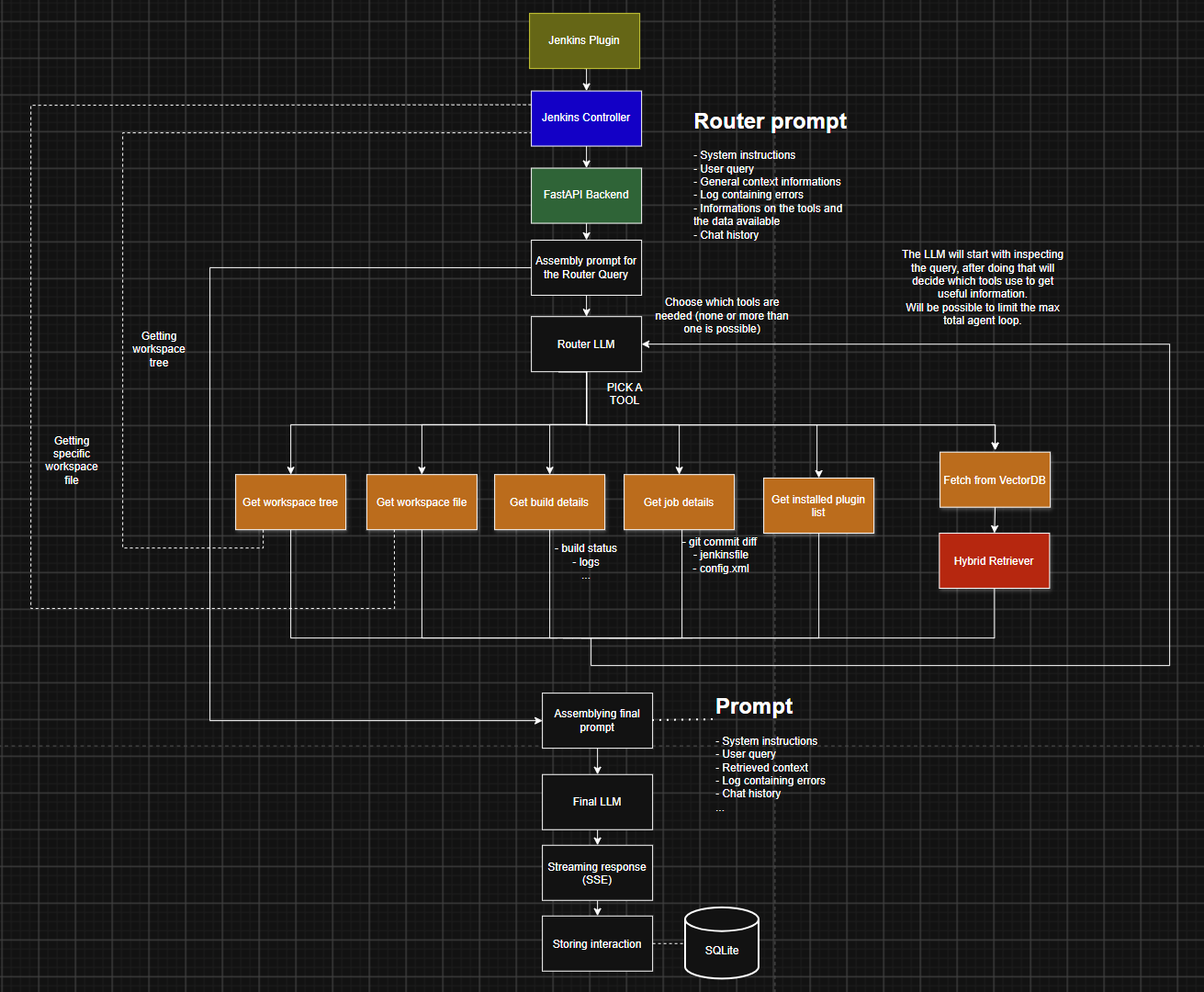
1. State Graph and Routing (agent.py)
The agent’s workflow is modeled as a state machine (StateGraph) handling the MessagesState. It relies on two distinct LLM clients (ROUTER_LLM and FINAL_LLM) to orchestrate the workflow safely and efficiently.
Key Nodes
Router Node: Analyzes the conversation history and decides the next step. It is bound to the domain-specific tools (e.g., fetching logs or files) as well as two explicit control tools:
ready_to_answeranddeclare_out_of_scope.Tools Node: A prebuilt LangGraph node that executes the requested tool and appends the result to the state.
Handle Tool Error Node: A self-correction mechanism that catches malformed JSON or tool call syntax errors, instructing the Router LLM to fix the syntax and retry.
Generate Final Response Node: Intercepts the final state, removes the routing metadata, injects critical directives (e.g., missing context handling or out-of-scope refusals), and triggers the
FINAL_LLMto formulate the final answer.
Circuit Breakers
The graph includes safety mechanisms to prevent infinite tool loops. If a tool returns a [MISSING_CONTEXT] error, the router is bypassed, and a critical directive is immediately passed to the final generator to alert the user.
2. Execution and Streaming (execute_agent.py)
The execution module is responsible for instantiating the LangGraph agent and streaming responses back to the client asynchronously.
Execution Modes
Production Mode (
execute_agent_prod): Optimized for end-users. It streams strictly the"messages"event, yielding only the final strings generated by theFINAL_LLMfor the UI.Debug Mode (
execute_agent_debug): Verbose execution used for internal testing. It tracks both"messages"(for intermediate router thoughts and tool calls) and"updates"(for state transitions between graph nodes).
Observability and State Management
Checkpointer: Uses
AsyncPostgresSaverto persist conversation state across turns.Tracing: Seamlessly integrates with Langfuse and LangSmith via callbacks, tagging sessions based on the execution environment (
prodvsdebug) and mapping them to the user’schat_id.